
IUCN WORLD CONSERVATION CONGRESS MOTION SERIES
On the Road to Half: Justice for Indigenous Peoples & the Biosphere
IUCN Motion 096
Amy Lewis, Managing Director, Policy & Campaigns, WILD
September, 2025
One of the major obstacles to a better relationship with wild nature is ensuring grassroots civil society is actually heard in policy debates at the national and global levels. For fifty years, WILD has created a powerful pathway for civil society engagement in the oftentimes exclusive policy sector through the World Wilderness Congress where all participants are delegates and vote to adopt global priorities in the years to follow.
In 2024, we convened the 12th World Wilderness Congress (WILD12) where twelve resolutions were adopted. We have worked to capture the spirit of these resolutions in the motions we submitted to the International Union for the Conservation of Nature (IUCN) this year in anticipation of the World Conservation Congress in October 2025. Motion 131 was born out of global collaboration and Indigenous-led vision. It emerged directly from WILD12’s Resolution 12 – Protecting the Sámi Forest: Safeguarding Biodiversity and Indigenous Livelihoods. This resolution was passed by 25 Sámi leaders and over 700 delegates from around the world.
Motion 096 now advances to the IUCN World Conservation Congress 2025, carrying forward the momentum of WILD12 to call for protection of at least 50% of Earth as the scientific-consensus spatial target, and recommend it be achieved in large part through the strengthening of Indigenous and local community land tenure for the purposes of conservation.
It is no coincidence that the 20th-century collapse of wild nature happened after the near completion of the imperial project that sought to eradicate Indigenous Peoples and place-based lifeways. Empire, after all, is anathema to nature and place-based living. Why, you may ask?
The entire point of empire is to conquer ever more distant lands and peoples for the benefit of the imperial center. Slaves, minerals, food, and treasure are shipped from the periphery to the core, thus removing (and sanitizing) the wholesale destruction of culture and nature to some unobserved corner of the globe, giving those at the center the plausible deniability that, while empire is undoubtedly a brutal endeavor, the average citizen has personally done nothing wrong.
And what is destroyed to nourish the empire is not just the physical systems that support life, but the non-physical, intangible systems as well – cultural knowledge, ritual, and tradition – that evolved to co-exist well with local ecosystems. These too crumble. Those who perpetuate these systems either die or conceal their identities (and thus their lifeways) in order to survive in a new order. Eventually, subsequent generations adopt, more or less, the lifeways imposed on them by the empire, and an entire dual social-ecological system that fostered respectful behavior towards nature vanishes.
As a conservation organization, WILD believes that the root cause of the ecological crisis is a broken relationship with nature, and we are constantly asking ourselves, what are some of the forces that broke our relationship with the natural world, and how can we repair them? In answering these questions, empire and conquest loom large. But what can one small (but mighty) NGO do to help reverse the damage and restore and/or rediscover the cultural knowledge and systems that were destroyed?
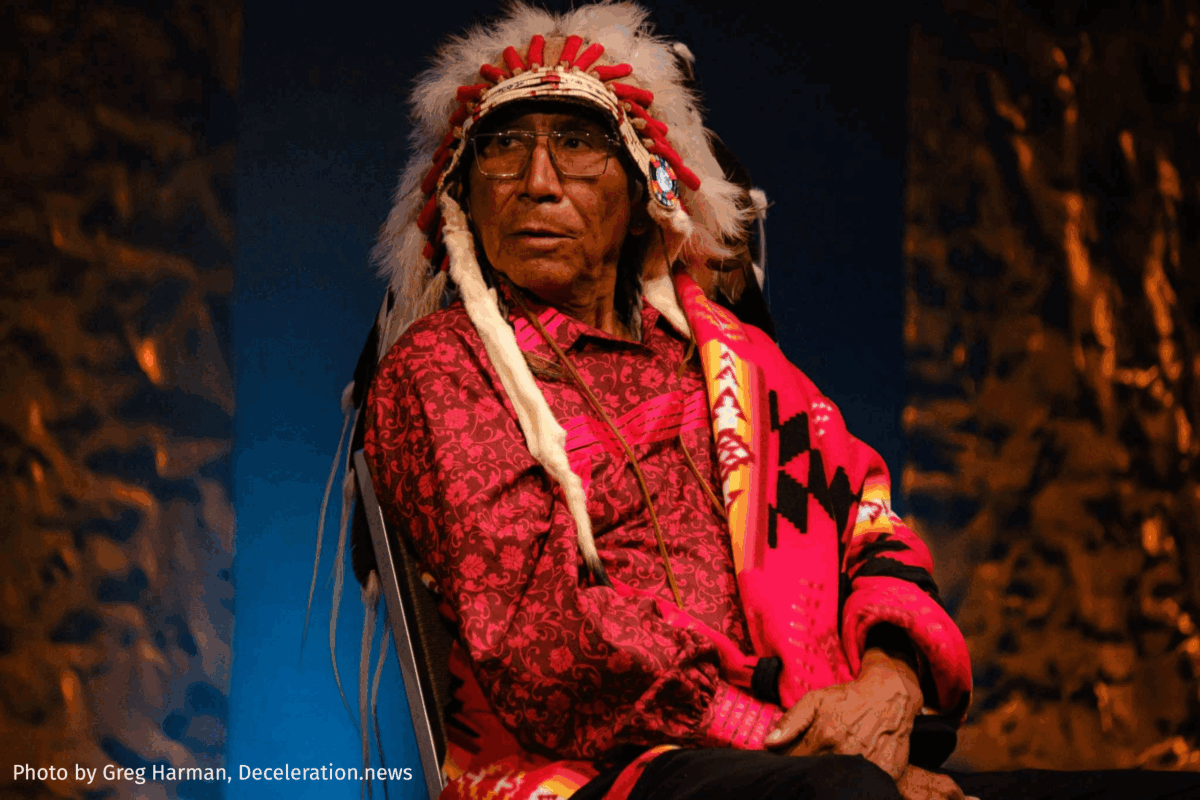
In pursuit of these answers, we asked the traditional leaders of the Oceti Sakowin (the Seven Council Fires) of the Lakota nation to host the 12th World Wilderness Congress (WILD12) and to share with us their perspectives and solutions for what must be done to restore a respectful relationship with Unci Maka, Mother Earth. With nearly 700 delegates from approximately 40 countries and dozens of Indigenous communities, WILD organized numerous working sessions and a resolutions process to make space for Indigenous solutions.
Over and over again, in a variety of ways, we learned that three things were needed:
Recognition of and partnerships with traditional Indigenous leadership grounded in respect for traditional lifeways. Cultures evolve naturally from within. Traditional does not always mean practicing cultural values as they were practiced 150 years ago. But it does mean change driven from within the culture, not imposed from without.
Restoration of traditional territories and ecosystems for the purposes of conservation. Indigenous delegates at the Congress recognized that what remains of their traditional lifeways are under assault by assimilating forces. They also recognized that the destruction of their territorial ecologies has contributed to assimilation as individuals within their communities could no longer practice traditional lifestyles. They requested strong alliances from conservation committed to restoring territories to traditional leadership for the restoration of ecology, spirituality, respect, justice, and a remedy for the disease of imperialism.
A more ambitious and authentic conservation sector. WILD12 delegates, both Indigenous and non-Indigenous, expressed significant cynicism about the conservation sector’s capacity to be authentic with itself. Believing that we harm ourselves when we imagine ourselves separated from nature (which manifests in actions like keeping intact nature reserved for protected areas and not something that is a right for all people to live within), delegates called for a deeper embrace of Indigenous leadership that can embed Indigenous values and principles within a conservation sector that was born within an imperial mindset.
These discussions led to the adoption of 12 resolutions, many of which call for the restoration of Indigenous territories to Indigenous leadership for the purposes of conservation. Four of these motions also call for stewarding at least Half of Unci Maka for intact nature simultaneous with the capacitation of Indigenous stewardship to achieve the science-based Half target. One of these motions includes Chief Arvol Looking Horse’s proposal to protect white animals, which are messengers of the sacred, by creating more space for them to be born into this world on lands and seas protected by Indigenous values and leadership.
We have translated these resolutions into 4 IUCN motions, Motion 96 being an amalgamation of several themes we observed.
While much time has been given to understanding how restoring Indigenous territories and lifeways must be a significant strategy to achieving the at least Half spatial target, it should also be noted that contemporary science also supports Half. Since the early 1970s, when the Odums first observed that wetlands began to precipitously lose ecological functionality once more than half of the landscape was destroyed, scientists have tested the Odum’s hypothesis in an increasing variety of landscapes, eventually culminating with Reed Noss’s call in 1994 to protect at least half of the biosphere in order to preserve its life-giving functionality.
Different ecosystems require different percentage targets. Rainforests need at least 80% intact, grasslands 40%. And these specificities must be considered when countries design their own spatial target roadmaps. But on average, globally, the total is at least half.
This target can be equated to a similar target in the climate sphere: 1.5 Degrees. And much like the Climate Convention, which has a political target of 2 Degrees, the Biodiversity Convention also has a politically determined target of 30%. Unlike the Climate Convention, however, in which everyone knows that 1.5 Degrees is the real, science-based target, few people outside of conservation scientists (over two-thirds of whom embrace the Half target) and in the general public know that at least Half is the actual target.
We call on the IUCN to help remedy this lack of transparency about how much nature people need to survive.
At WILD12, there was an uncomplicated embrace of the Half target because the delegates were suffused with the knowledge that Indigenous lifeways offer an alternative and complementary model to traditional protected areas. Additionally, they believed that the Indigenous approaches to the stewardship of nature, if strengthened sufficiently, could help educate and transform mainstream society by fostering a deeper connection and relationship with place-based nature.
In light of these facts, WILD and our co-sponsors respectfully request that the IUCN General Assembly adopt Motion 96 and the at least Half spatial target with the explicit condition that this target also be used to restore Indigenous territories and capacitate Indigenous leadership for the purposes of conservation, a transformative reform of people’s relationships with nature, and the preservation of the biosphere.
Learn more about Motion 096: